
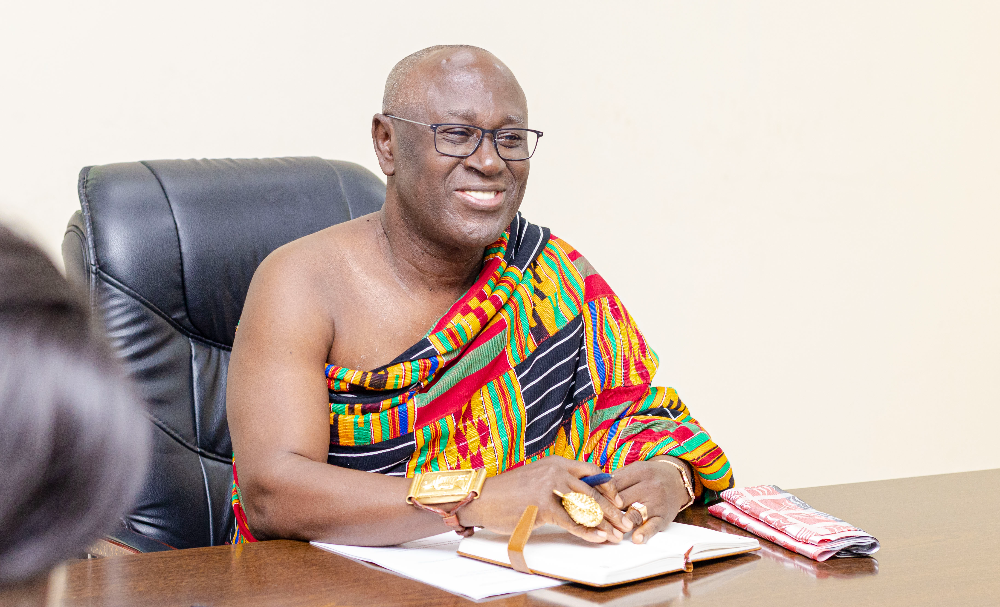
When Council Chairman Akyamfour Asafo Boakye Agyemang-Bonsu meets academics, he does not settle for ceremony. He asks questions.
And often, they linger.
His line of inquiry during recent engagements across colleges and directorates at the Kwame Nkrumah University of Science and Technology, Kumasi (KNUST), has revealed a governing style shaped by curiosity and a deep interest in systems.
It also revealed something more personal.
In a moment that drew laughter, the Council Chairman turned to a professor who had introduced himself earlier as a former student at Prempeh College.
“When did I teach you?” he asked Professor Emmanuel Acheampong, a scholar of silviculture and forest management.
“In 1990,” Prof. Acheampong replied.
“1990? Lower Sixth and Upper Sixth,” Akyamfour Agyemang-Bonsu said, before adding with a smile, “and you’ve never looked for me,” prompting laughter across the room.
The exchange hinted at a fortuitous dimension of his tour: a teacher reconnecting with a generation that has become teachers themselves.
Questions that probe systems
At the College of Agriculture and Natural Resources on May 27, 2025, his questions turned to agricultural practice and context.
“I love the greenhouse,” he said, “but I would ask the Provost that question. Why would I do greenhouse in Ghana? What was the origin of greenhouse use in crop production? Why would I, in the tropics, use greenhouse for production?”
The questions pointed less to the structure itself than to issues of appropriateness, adaptation and the transfer of systems into local realities.
At the College of Art and Built Environment, his attention shifted to spatial planning and land use, which he described as persistently challenging.
“How has research into spatial planning been, and how has land use been addressed?” he asked, highlighting what he sees as a gap between knowledge and implementation.
It was on land management, however, that one of his many forward-looking ideas emerged.
Ghana’s land allocation systems, though evolving, remain complex and often fragmented. For Agyemang-Bonsu, the solution lies in digital transformation.
“My concept, using blockchain technology, is to develop a system where land allocation is done on a blockchain,” he said. “I want to assign specific identification numbers to every plot of land I allocate.”
The idea is not theoretical. As Asafohene, he has developed the Dinpa Integrated Land Management System, a platform informed by blockchain principles.
“I can input the coordinates of any land,” he said, describing a system designed to improve traceability and reduce human error.
He also pointed to inefficiencies in how land data is currently shared.
“That’s one area I would have liked to see from the Lands Commission or the Planning Department,” he said. “Instead of transmitting hard copies for retyping, can they send coordinates as SML files that I can import directly into my system?”
Across engagements at the Colleges of Humanities and Social Sciences, Engineering, Health Sciences and Science, his questions have consistently pushed for deeper reflection on systems and relevance.
For KNUST, the visits signal a leadership approach that places systems thinking, technological adaptation and institutional relevance at the centre of governance.
And for many in the room, the message is clear.
The teacher is back, and he is still asking questions.
| Story: Emmanuel Kwasi Debrah |


